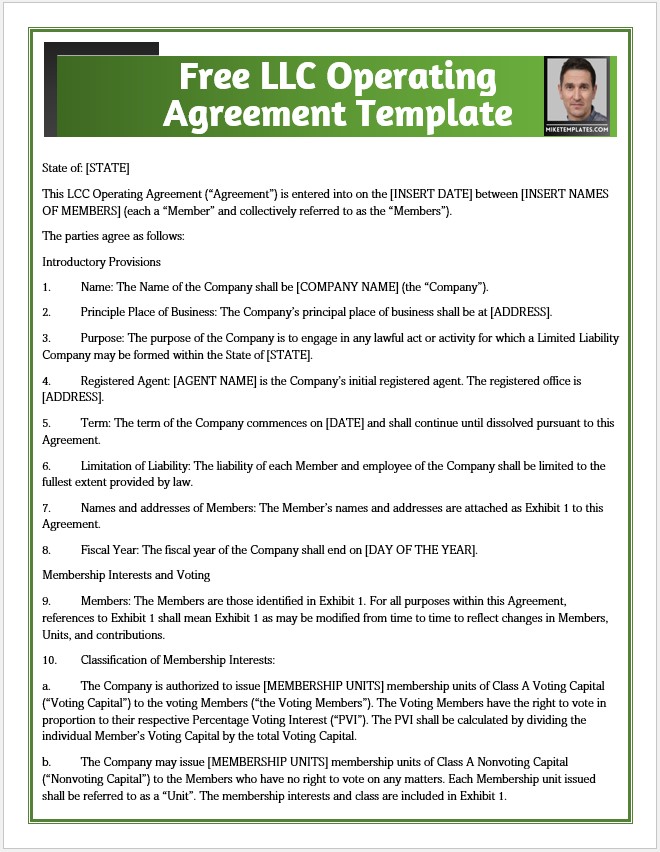
Download free, fully‑editable LLC Operating Agreement templates in Microsoft Word. Includes single‑member, multi‑member, manager‑managed, series‑LLC and professional‑LLC agreements plus a step‑by‑step customization guide. You can explore all of our Agreement Templates to find one suitable for your requirements.
The establishment of a Limited Liability Company (LLC) provides the advantages of both liability protection and taxation flexibility, but the absence of a Written Operating Agreement allows the internal regulations of the company to stay unclear, and default rules that differ from the members’ intentions may be imposed by state courts. An Operating Agreement determines the management of the LLC, the distribution of profits and losses, the procedure of voting and decision-making, the terms for the admission of new members or the expulsion of old ones, the situation occurring at a member’s death or departure, and finally, the company’s winding-up procedure. A single, enforceable document containing these details protects the company’s limited-liability shield, prevents expensive quarrels among members, and gives a straightforward guide for investors, lenders, and tax authorities. Since almost every computer has Microsoft Word pre-installed, we have put together a library of free templates for fully-editable LLC Operating Agreements that you can download, customize, and sign within minutes—this means that you get legal protection for any LLC with one member or many right away.
What Is an LLC Operating Agreement?
An LLC Operating Agreement is a private contract among the members (owners) of a Limited Liability Company that governs the internal affairs, management structure and financial relationships of the entity. The agreement begins by identifying the LLC’s legal name, formation date, principal office address and the state of organization, followed by a clear statement of whether the LLC is member‑managed (all members participate in day‑to‑day decisions) or manager‑managed (one or more designated managers, who may be members or third parties, run the company).
Core provisions typically include:
Capital Contributions – the amount of cash, property, or services each member contributes at formation and any future contribution obligations.
Ownership Percentages – each member’s percentage interest in the LLC, which determines voting power and profit‑and‑loss allocation.
Profit and Loss Allocation – how net income, losses, deductions and credits are divided among members, often in proportion to ownership percentages unless otherwise agreed.
Voting Rights and Decision‑Making – the threshold for member approval on ordinary matters (often a majority) versus major actions (mergers, amendment of the agreement, dissolution) which may require a super‑majority or unanimous consent.
Management Structure – description of the powers and duties of managers (if manager‑managed), the process for appointing or removing managers, and any limits on their authority.
Member Withdrawal, Death or Incapacity – procedures for a member to voluntarily withdraw, for the LLC to buy out a departing member’s interest, and for the transfer of a member’s interest upon death or disability, often including a right‑of‑first‑refusal for the remaining members.
Additional Capital Calls – the circumstances under which the LLC can require members to contribute additional capital, and the consequences for a member who fails to meet a capital call.
Distributions – the timing and method for cash or property distributions to members, separate from profit allocation, and any preferred‑return provisions.
Tax Treatment – an acknowledgment that the LLC will be treated as a partnership for federal tax purposes (unless an election is made to be taxed as a corporation), and that each member will receive a Schedule K‑1.
Indemnification and Limitation of Liability – provisions that protect members and managers from personal liability for the LLC’s debts and obligations, and that limit liability for breaches of fiduciary duty to the extent permitted by law.
Dissolution and Winding‑Up – the events that trigger dissolution (e.g., unanimous vote, expiration of term, judicial dissolution), the steps for winding up the LLC’s affairs, and the distribution of any remaining assets.
By codifying these elements, the Operating Agreement gives the LLC a clear governance framework, preserves the liability shield, and provides evidence of the members’ intent should a court need to interpret the company’s internal affairs.
Free LLC Operating Agreement Templates:
Here are previews and download links for these free templates in MS Word format.
Please click the download button for this LLC Operating Agreement Template 01 below,
How to Use an Operating Agreement Sample in Word?
Open the downloaded Word file and read each clause to understand its purpose. The template uses bracketed placeholders such as “[LLC Name]”, “[Formation State]”, “[Member 1 Name]”, “[Capital Contribution]”, “[Ownership Percentage]” and “[Governing Law]”. Replace every placeholder with the exact information for your LLC.
In the Capital Contributions part, detail the cash that was contributed initially by each member, any property that was contributed, and the market value of the services performed if they were rendered. If the contract has a future capital-call provision, then state the events (e.g. a cash flow shortage) that will trigger the call and the time required to give notice.
When the document states the Management Structure, clarify if the LLC has a management of the members or a management of the managers kind. If management of the managers, provide the name(s) of the manager(s), their authority, the voting rights of the managers compared to the members, and the procedure for the removal or appointment of managers.
In case you are making an Operating Agreement for a Series LLC, the template has an additional exhibit for every series, which details the assets, liabilities, and members designated to that series, along with the internal accounting method for isolating the series’ finances.
Since Operating Agreements have a direct impact on tax categorization, rights of ownership and duties of trust, it is very much recommended that each partner gets separate legal advice prior to signing. A lawyer can check for the IRS partnership regulations that the profit-and-loss allocation is according to, the state legality of the buy-out formulas, and the compliance of the indemnification language with the statutory limits of your area.
Please click the download button for this LLC Operating Agreement Template 02 below,
Popular Types of LLC Operating Agreements
When you decide which operating‑agreement format to adopt, start by evaluating the number of members, the desired management style, whether you need separate series for distinct assets, and any industry‑specific requirements (such as professional licensing).
Single‑Member LLC Operating Agreement
The Single-Member LLC Operating Agreement is the most straightforward choice for a sole proprietor who wishes to legitimize the LLC’s existence, isolate personal assets from business liabilities, and describe a basic management structure (the sole member taking all decisions). This document usually contains a statement of capital contribution, a clause allowing the member to appoint a manager (if he so chooses), allocation of profits (100% to the sole member), and a clause for dissolution of the LLC.
Member‑Managed Multi‑Member LLC Agreement
A Member-Managed Multi-Member LLC Agreement is suitable for small groups of people in which every owner is willing to take part in daily management. The contract lists the voting rights (usually in line with ownership), a simple majority for routine issues, and a super-majority (or unanimous) vote for things like new members, changes to the agreement, or closing down the LLC that fall under major actions. A capital-call provision is also included in the agreement which allows the LLC to ask for further contributions in case of cash shortage, and a buy-out formula is provided for a member wanting to leave.
Manager‑Managed Multi‑Member LLC Agreement
It is a suitable situation when the members of the LLC do not want to take part in the management and prefer to give all the managerial powers to the managers, whether they are members or outside professionals. The Manager Managed Multi Member LLC Agreement defines the limits of the manager’s authority (like making contracts, employing people), payment (is it salary or share in profit), the procedure of dismissing or substituting a manager, and members’ voting rights for important decisions (like selling almost all the assets, changing the agreement).
Series LLC Operating Agreement
When a parent LLC decides to create several “series” that are legally distinct and hold separate assets and liabilities, which is often the case in real estate portfolios, investment funds or franchising structures, a Series LLC Operating Agreement becomes necessary. The main agreement specifies the right to create series, the separation of assets, the liability protection between series, and the accounting way of distributing income and expenses. Individual attachments for each series show the detailed members assigned to that series, their capital contributions, ownership stakes, and profit-sharing agreements.
Professional LLC Operating Agreement
In most states, a Professional LLC Operating Agreement is obligatory for licensed professionals (lawyers, doctors, and accountants). The draft contains stipulations such as every member having to possess an up-to-date professional license, the LLC providing no protection against personal malpractice liability for the members, and the members agreeing to keep professional malpractice insurance. Additionally, it might include a clause pertaining to adherence to ethics rules and a non-compete clause that conforms with the restrictions of the relevant professional code.
LLC with Preferred‑Return Member
An LLC with a Preferred Return Member is meant for those investors who get a preferred return (for example, 8% a year) before any other members receive their share of the profit. The contract lays out the preferred return calculation method, the waterfall distribution after the preferred return is satisfied, and the rights of the preferred-return member in case of a sale or liquidation.
LLC with Vesting Schedule
It is quite usual for the startups to have an LLC with Vesting Schedule in which the founders prefer their ownership interests to be given up gradually (for instance, a four-year vesting schedule with a one-year cliff). The contract specifies the milestones for vesting, the repercussions of a founder leaving before the end of the vesting period (loss of unvested interests), and the terms for acceleration in case of a change of control.
LLC for Real‑Estate Investment
The obligations for capital contributions in the form of real estate, a precise income and expense allocation reflecting every member’s input, a cash-flow distribution plan linked to rental income, and a non-ambiguous exit strategy (property sale or refinancing) are usually part of an LLC agreement for Real Estate Investment.
LLC for E‑Commerce Business
An E-commerce business LLC can choose to include a member loan clause in their agreement, which permits members to lend money to the company with specific interest rates and payment conditions set, alongside a revenue sharing provision, making the distribution of the profits proportional to the contributions of each member in terms of sales.
The Operating Agreement can be drafted by picking a template that reflects the exact outline and purposes of your LLC or by blending clauses from various documents mentioned above, so the management power, profit sharing, liability safety and departure roads are assigned accurately to the company, thus securing the company’s assets and reducing the chances of conflict caused by the company’s internal relations.